The International Dance Council CID, official partner of UNESCO, validates teaching by offering FREE OF CHARGE to its Members the International Certification of Dance Studies.
Outline:
1. Each level is 150 hours of instruction.
2. The school, the teacher and the student are Members of CID.
3. The school sends to CID a declaration that the student has completed 150 hours.
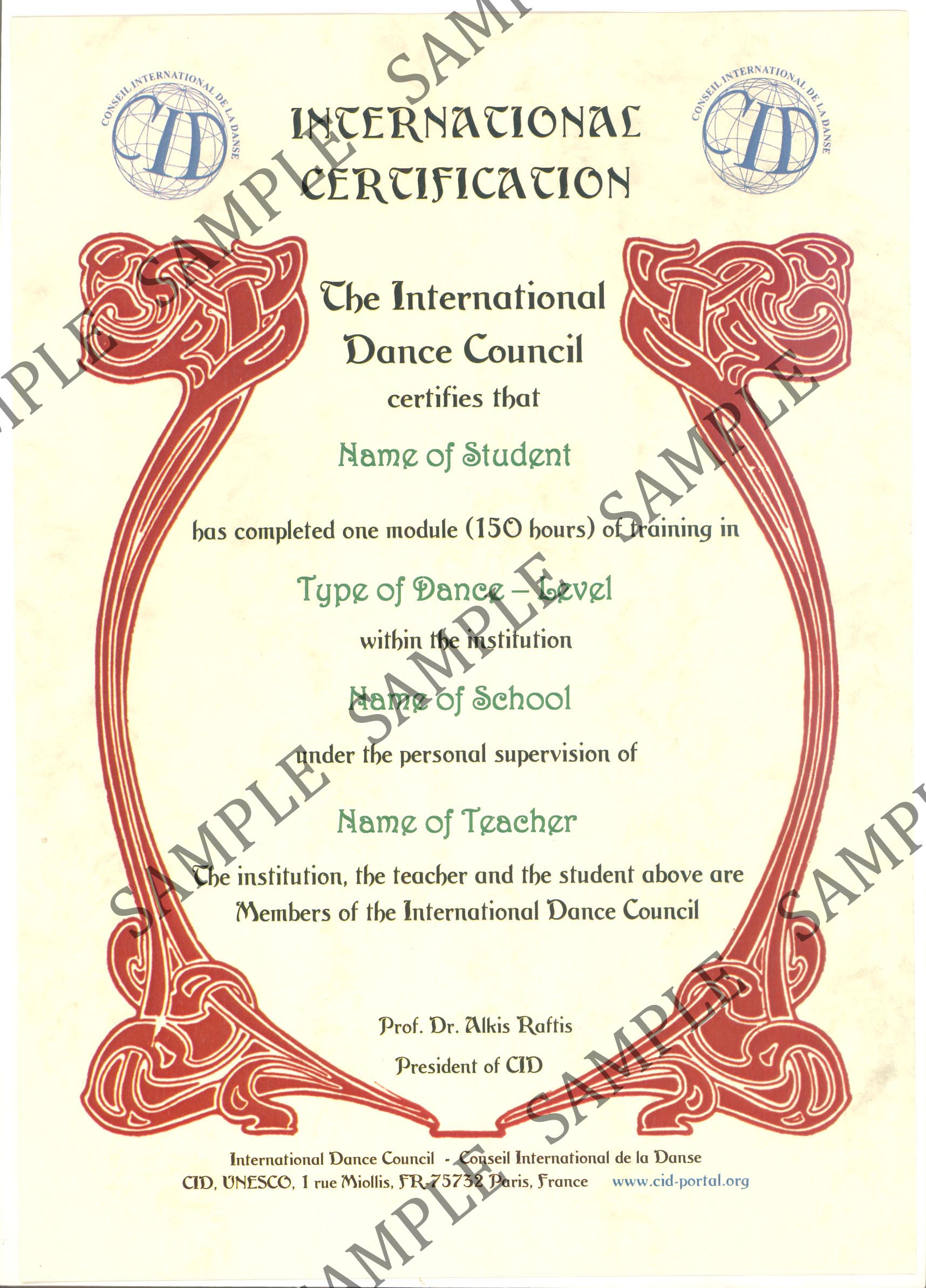
4. CID sends formal Certification on parchment paper, valid world-wide. An official hands parchment to the student at a special ceremony.
5. After Level 1 the student can proceed to Level 2 (another 150 hours) then another 150 hours for Level 3, according to the requirements of the school.
6. This applies to all countries, all forms of dance.
7. It is free of charge, like all services provided by CID.
Guarantees
Only CID can offer solid guarantees since it is:
– official, recognized by governments, partner of UNESCO
– world-wide, in more than 170 countries
– independent from any influences or interests
– global, not linked to any particular country
– strictly non-profit, accepting no money other than membership fees
– democratically governed by elected officers
– firmly established, with a long history of 44 years
– competent, bringing together top-level specialists
– encompassing, absolutely all forms of dance
Characteristics of CID certification
– Uniformity: system is the same for all countries.
– Verification: inquiries on certified students are confirmed by CID.
– Security: certificates are issued centrally, by the CID Secretariat
– Selection: schools, teachers and students are members of the CID
– Equality: all forms of dance, all tendencies
– Stability: will never change
– Flexibility: can be given in addition to other qualifications
– Gratuity: always free of charge
Procedure for
International Certification of Dance Studies
1. The teacher or director of the school is admitted to CID as Member.
2. The school is admitted to CID as Member, nominated by the teacher.
3. The teacher sends a filled a form for each student having completed 150 hours.
4. The students are admitted to CID as Student Members, nominated by the teacher.
5. The Executive Secretariat of CID sends to the school International Certification.
6. The School Director or an important personality of the city hands parchment to the students at a special ceremony.
7. A student can continue for another 150 hours, for example: Ballet Level 5, Tango Level 2, Dance Therapy Level 3.
8. Assuming 38 working weeks in a year:
4 hours a week x 38 weeks = 152 hours, that is a Level in 1 year
2 hours a week x 38 weeks = 76 hours a year, that is a Level in 2 years
1 hour a week x 38 weeks = 38 hours a year, that is a Level in 4 years.
9. Total cost is only membership fees: for teacher + for school + for each student’s membership. Certification is free of charge.
Student data for Certification
Please return this form after filling it for each student/dancer you nominate for International Certification of Dance Studies.
Full name of student:
Postal address of student:
Email address of student:
Fixed telephone:
Mobile telephone:
Type of dance:
Level:
Name of school:
Name of teacher:
Remarks:
Certification is free of charge.
– Data in bold characters above will be printed in English on the Certification parchment. Make sure the spelling is correct.
– Type of dance must be one only, for example: ballet or tango or ballroom or dance therapy etc., in English.
– Level must be a number, that is 1 or 2 or 3. Each level is 150 hours. No more than one Certification in a year.
– Documents are sent to the school, not to students.
– Ask students to validate their email address at: https://cid-world.org/gdd
– Please make sure the awarding ceremony shows the importance of International Certification. Invite parents, personalities, journalists, officials. Post photos from the ceremony at the Facebook page: https:/www.facebook.com/groups/1669368256675201/
Guidelines for International Certification
- Student data
– Use Mr. or Ms. (to ensure clarity).
– Write the family name in capital letters (e.g. Mr. John SMITH). Use the full name as it appears on the identity card. Use the Roman alphabet (without accented letters).
– Provide the full postal address. Include email and phone number(s) (specify if mobile).
– Specify the genre of dance using internationally accepted terms (e.g., Ballet, Bharatanatyam, Ballroom, Bellydance). Avoid terms like “advanced,” “professional,” “intermediate,” or “teacher”.
– The level is only a number: 1, 2, or 3 (up to 10). Each level corresponds to at least 150 hours of classes.
- Student age
– The student must be at least 7 years old on the day of the awarding ceremony. There is no upper age limit.
– Students under 16 register as Youth Members (reduced fee), and their personal data is not published online. Older: Students 16 or older pay the standard membership fee.
- Former students
– You can award Certification to students who attended your school years ago. This gesture can bring them joy and recognition, and encourage them to return for further levels.
- Limits per year
– A student may receive only one Certification per dance genre in a year, even if they complete 300 hours.
– A student can receive two Certifications in the same year if they complete 150 hours in each of two different dance genres.
- School name
– Must be short, no more than four words.
– Use only the official name of the school, without subtitles or additional descriptors.
- Teacher’s name
– Must be short, no more than four words.
– Up to two teachers’ names can appear on the Certification document, provided: both are CID Members, and the combined names are not excessively long.
– Use legal names as they appear on official identification (e.g., identity card), not artistic or stage names.
- School requirements
– The School Director reserves the right to withhold Certification even after the student completes 150 hours, or require the student to take additional classes, or pass an internal examination before awarding Certification.
- Same school requirement
– The student must have completed all 150 hours at the same school.
– All names listed on the Certification must belong to CID Members.
- Content of the 150 hours
– The 150 hours can include: class hours, rehearsals, performances, examinations, theoretical lectures (e.g., theory, anatomy, dance history).
– The School Director may also grant credit for studies outside the school, such as: other dance genres, university degrees, performance experience, online classes.
– The Director sets the specific requirements for awarding a Level, with 150 hours as the minimum.
– CID aims to standardize the organization (not the content) of dance studies across all countries and dance genres.
- Teaching program
– No standardized syllabus is required, each school designs its own curriculum and examination content.
– The School Director ensures the quality of instruction and the accuracy of information provided.
- Certifying a teacher
– A teacher requests certification from their own teacher.
– A teacher does not need to be certified to award Certification to their students.
– The number of Certifications a teacher awards serves as an indicator of their recognition and approval within the community.
- Responsibilities
– The School Director is responsible for determining the method, duration, and details of instruction.
– All official documents are sent exclusively to the Director, not to students.
- Certification vs. certificate
– Certificate is a document issued by a school to its students, confirming their participation or completion of a course.
– Certification is awarded by an independent, third-party organization of higher authority. It validates or confirms the facts declared by the school, ensuring credibility and recognition beyond the issuing institution.
- Who can teach dance
– Dance is an art, and there are no restrictions on who can teach it—thankfully!
– Anyone can teach dance, just as anyone can practice it.
– Teaching qualifications help inform the public about a teacher’s background, but they are not legally valid unless recognized by a government. Most teaching qualifications are not government-recognized.
- Promotion
– The more you promote your privilege of offering International Certification, the more students you will have
– Use social media, print media, radio, and TV. Send messages, distribute flyers, and post stickers in high-traffic areas.
– Ask your students to do likewise; they can reach a young audience.
- Government recognition
– CID is in touch with National Delegations at UNESCO and Ministries of Culture or Education regarding the recognition of the International Certification by governments.
- Other qualifications
– The International Certification does not replace other qualifications, such as diplomas, certificates, or licenses.
– It is awarded as an additional credential to support professional mobility.
– While many examiners are CID Members, CID itself does not organize examinations or appoint examiners.
- Caution
– Many associations and businesses present themselves as international organizations, offering teacher diplomas, championships, certificates, competition prizes, and degrees.
– However, these documents often hold little to no value outside their own network or country.
19. More details at:
www.CID-world.org/certification
www.facebook.com/groups/CID.InternationalCertification
Instagram #CIDDanceInternationalCertification

